News You Should Know: Income, Wealth on the Rise Along With Money Stress

Fed Says Household Income, Wealth, Debt Stress Increased From 2022 to 2025 | Reuters

There’s mixed news in the latest release of the Federal Reserve’s Survey of Consumer Finances. According to the survey, many American families saw increases in incomes and wealth from 2022 to 2025, but there are signs that more families are experiencing financial stress, as well. Debt is a challenge for many, with median debt payment as a share of income and debt-to-income ratios increasing over the three-year period.

IRS Clock Ticks Down on Retirees With Unfinished 2026 RMDs | TheStreet

The end of the year is quickly approaching, and so is the deadline for taking minimum required distributions (RMDs) from defined contribution retirement accounts like IRAs and 401(k)s. Here’s what to know about who’s required to take distributions this year and how to calculate your RMD amount.

Look for These 3 Attributes in a Financial Advisor | NerdWallet

Working with a financial advisor can make a big difference when it comes to making your financial goals a reality. If you’re looking for an advisor or just recently started working with one, here are some key questions to ask to make sure your advisor is a good fit.

Denver High School Students Given $1,000 to Invest | 9News

Some Denver high school students are getting a jumpstart on their savings goals and financial education with a free gift of money to invest. The program provides each student with $1,000 to build an investment portfolio and lessons in how to manage it. After the students complete the program, the $1,000 is theirs to keep.


News You Should Know is a digest of news from publications around the nation about finance, investing, and retirement.

Assessing the Impact of the Social Security Fairness Act

It’s been nearly two years since Congress passed the Social Security Fairness Act and repealed Social Security’s Windfall Elimination Provision (WEP) and Government Pension Offset (GPO). A recent report from the Congressional Research Service (CRS) describes the bill’s implementation and its impact on affected public employees as well as Social Security’s finances.

Background

For decades, WEP and GPO reduced Social Security benefits for retirees who also received retirement income from work that wasn’t covered by Social Security. Because most public employees in Colorado do not contribute to Social Security, many faced reductions under WEP and GPO if they or their spouse contributed to Social Security outside of their public sector employment.

Federal lawmakers had tried for many years to remove or modify WEP and GPO, but those bills never made it to the floor of the House or Senate for a vote. Then in late 2024, Congress passed the Social Security Fairness Act, and then-President Joe Biden signed the bill into law in early January 2025.

Following the bill’s passage, the Social Security Administration began the process of recalculating affected workers’ Social Security benefits and issuing retroactive lump sum payments for benefits going back to January 2024, the bill’s effective date.

Public Employees Previously Affected by WEP/GPO

WEP and GPO mainly affected two groups: State and local government employees in states like Colorado where they are covered under alternative retirement plans, and federal employees hired before January 1, 1984. According to the CRS report, Colorado was among nine states that accounted for about 60% of affected workers nationwide.

As of the most recent update in July 2025, the Social Security Administration said it had made more than 3.1 million payments to eligible beneficiaries totaling $17 billion, with an average retroactive payment of $7,208.

In addition, the Social Security Administration received 387,000 new Social Security claims from people who may be entitled to back payment.

In Colorado, Social Security reported 91,241 cases totaling over $599 million in retroactive payments that were processed through large-scale automation. That total does not include more complex cases that required manual processing, so the full impact isn’t yet clear.

Social Security’s Finances

Because the Social Security Fairness Act increased benefit payments for affected beneficiaries, it increased costs for the program as a whole. According to the Congressional Budget Office (CBO), the bill is expected to increase Social Security spending by about $198 billion over 10 years.

That increase in spending slightly worsens Social Security’s financial outlook; the CBO estimates the depletion date of Social Security’s trust funds would advance by about six months due to the Social Security Fairness Act.

According to the most recent report from the Social Security and Medicare Boards of Trustees, the Old-Age and Survivors Insurance (OASI) Trust Fund, which pays retirement and survivor benefits, has enough money to pay full benefits until late 2032. After that, Social Security will only be able to pay about 78 percent of scheduled benefits.

The impact on Social Security isn’t entirely negative, however. The CRS report states WEP and GPO were a major cause of Social Security overpayments, so the SSFA reduces that risk and removes the administrative burden of collecting and verifying pension details.

What’s Next?

There’s a great deal of uncertainty around what the future of Social Security looks like. With less than a decade until the program exhausts its financial reserves, momentum is building in Washington, DC to take action sooner rather than later.

Congressional lawmakers on both sides of the aisle have proposed changes, including raising the cap on income subject to Social Security payroll taxes or rethinking the system’s investments. There have also been discussions about creating a commission or advisory board to oversee legislative attempts at Social Security reform, though nothing has been decided.

PERA On The Issues will continue to follow this issue and share updates as they’re available. Be sure to subscribe to our newsletter to stay in the loop.

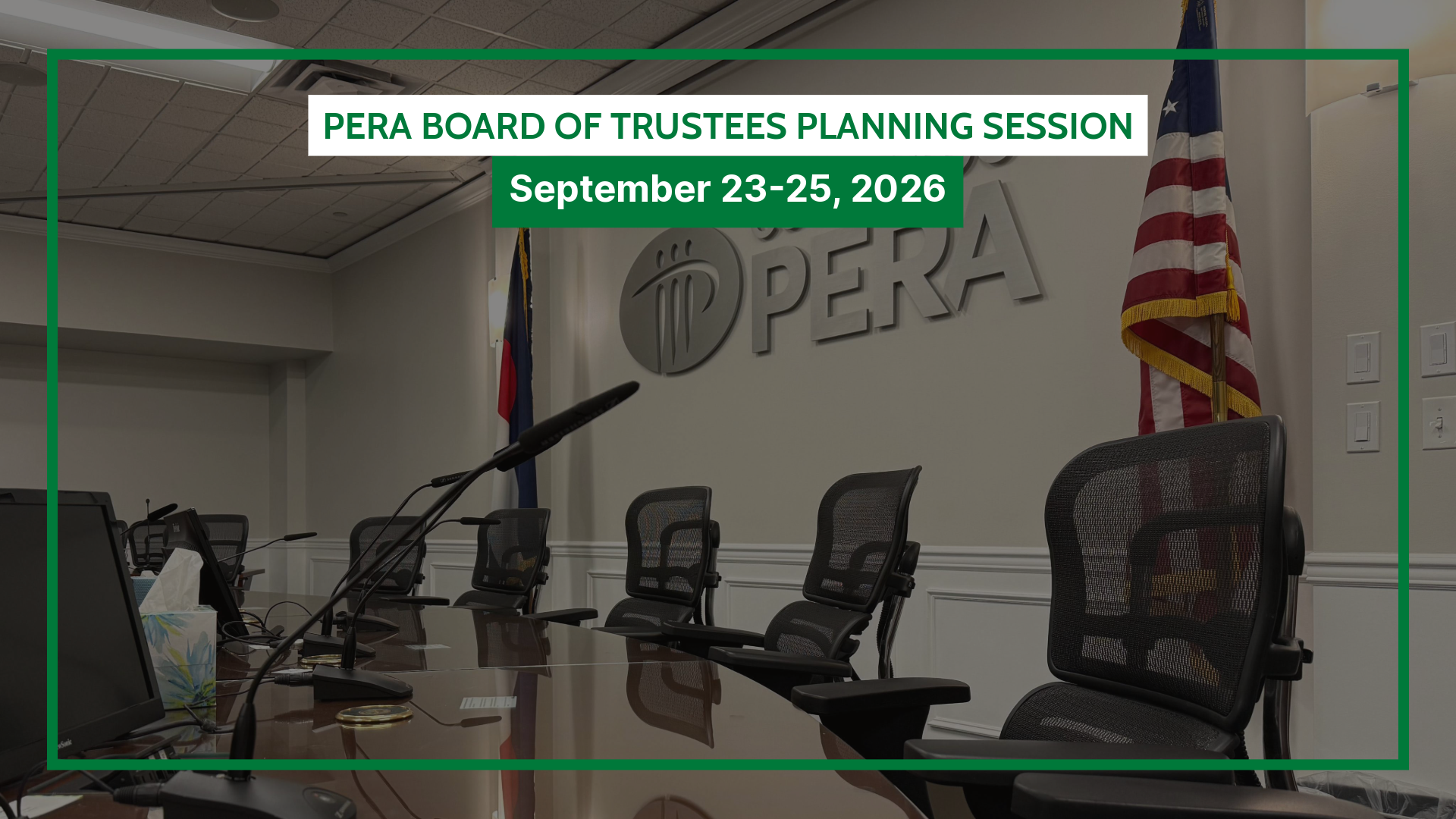
Here’s What the PERA Board Tackled at Its 2026 Planning Session

The Colorado PERA Board of Trustees met in Colorado Springs for its annual planning session from September 23 to September 25.

The three-day planning session and Board meeting is a valuable opportunity for Trustees to engage in more in-depth conversations and planning activities than a typical one-day meeting allows. This year’s session included topics such as staff compensation, healthcare costs, service improvements, investment management, and strategic planning.

New Trustees and Vice Chair

One of the first items of business was to welcome two new Trustees to the Board. Chad Marturano, Vice President and Chief Financial Officer for the University of Colorado System, joined the Board in July after being elected to the State Division Higher Education seat. Tristan Gearhart, Chief Planning and Finance Officer for Colorado Springs Utilities, was appointed to fill the Local Government seat vacated by outgoing Trustee Trina Ruhland.

The Board also selected a new Vice Chair following the departure of previous Vice Chair Ruhland. Denver Public Schools (DPS) Trustee Amy Grant was the sole nominee for the position and was appointed Vice Chair. The Board will hold regular elections for Chair and Vice Chair at its November meeting, with terms beginning with the Board’s January 2027 meeting.

Staff Compensation and Incentive Pay

One of the PERA Board’s duties is setting the overall direction of staff compensation to ensure PERA can hire and retain qualified staff to serve our members and meet the objectives in the Board’s strategic plan. It does that through adoption of a Total Compensation Philosophy, which governs compensation for staff across the organization, and an Investment Department Compensation Philosophy, which lays out the compensation framework for the investment team, some of whom are eligible for performance-based incentive pay.

The Board’s consultant, Aon, presented several potential adjustments for the Board to consider at its next meeting in November to better align with industry best practices, improve transparency, and ensure pay continues to reward strong performance. Possible changes include:

  • Establishing a consistent schedule to review CEO pay based on market trends and the Total Compensation Philosophy;
  • Formalizing review of the Investment Department Compensation Philosophy on the same cadence as the Total Compensation Philosophy;
  • Making adjustments to incentive pay weighting for the CEO and investment staff to place more emphasis on total fund performance;
  • Defining how incentive pay is handled during years when the plan earns unfavorable returns.

The Board will hold another discussion at its November meeting before finalizing any potential changes.

PERACare and the Healthcare Market

Director of Insurance Jessica Linart and PERA’s health insurance consultant, The Segal Group, facilitated a discussion about the healthcare market and price trends.

In general, healthcare costs have been rising for years, with prescription drugs seeing the largest average price increases year-over-year, Segal said. There are many factors that can influence plan costs like premiums and copays, and the conversation focused on some of the most significant drivers of recent price increases, including:

  • Innovation and technological advancements: There have been major breakthroughs in diagnosis and treatment of various conditions in recent years, and those innovations tend to be more expensive than existing services, which can drive up plan costs.
  • Patient health and plan utilization: Aging populations that require more care, growing prevalence of chronic conditions, and increased use of diagnostics and preventive care contribute to insurance plans paying for more doctor visits, treatments, and medications.
  • Market dynamics: Trends in the healthcare market such as provider consolidation, coupled with inflation, are leading to higher costs for consumers and insurance carriers alike.
  • Regulatory and policy changes: Changes in legislation and policy at the federal level, such as drug price negotiations and changes to reimbursement rates, can result in plans bearing additional costs that can increase month plan premiums.

Linart also highlighted changes coming to PERACare next year, including new carriers and plans. PERACare information for 2027 is available now and open enrollment runs through November 19. For more information, visit the 2027 PERACare Open Enrollment page.

Legislative and Government Affairs

Director of Public and Government Affairs Michael Steppat joined the Board for an update on the current legislative landscape and the 2027 lawmaking session.

Steppat pointed out that legislators are once again facing the prospect of having to make significant spending cuts to pass a balanced budget. While PERA does not rely on the State budget for its own operations or paying benefits, the General Assembly makes an annual $225 million direct distribution to PERA and the State of Colorado as an employer makes contributions that could be subject to legislation.

While Steppat and other PERA leaders typically meet with various legislative bodies during the period between legislative sessions, lawmakers paused most interim activity this year due to budget constraints. PERA appeared before the Legislative Audit Committee in August and the next legislative appearance will be an annual hearing with the Joint Budget Committee in November or December.

The 2027 legislative session will get underway on January 11, and PERA On The Issues will keep track of any PERA-related bills as they make their way through the legislative process.

Service Improvements

One of the key goals in the PERA Board’s strategic plan is improving the experience of PERA members and other stakeholders through the services and information we provide. To that end, the Board discussed the results of two assessments that gauge how much progress PERA has made in recent years.

The Board receives a report every year from CEM Benchmarking that scores PERA on the quality and cost of services we provide to members and compares those factors to other public pension plans.

PERA earned a service score of 89 for 2025, an increase from last year and higher than the peer median score of 82. CEM calculated PERA’s total administrative cost per member at $77, below the peer average of $80. Overall, the CEM report finds PERA provides a higher level of service at lower cost than the average pension plan.

PERA continues to earn high scores in areas such as the accessibility of online services, speed of processing retirements, communications to members approaching retirement, and call wait times.

The Board also discussed the results of PERA’s member satisfaction and retirement confidence survey, which takes place every two years. That survey provides a Net Promoter Score (NPS) that quantifies how well members and retirees are satisfied with PERA services and information.

This is the fourth year since 2019 PERA has conducted the survey, and this year’s results showed meaningful improvement—the NPS was 17 (on a scale of -100 to 100), up from -5 in 2019. Overall, retirees tend to be more satisfied than active members, and many of the survey respondents who were dissatisfied mentioned outside factors, such as the economy and political issues, as reasons for their negative outlook. Active members showed the largest change in 2026, with satisfaction increasing 12 points.

The PERA Board and staff continue to prioritize service improvements as we work to meet the changing needs of our members, employers, and other stakeholders.

Private Market Governance

The Board regularly receives education and information to help inform organizational strategy, and this year’s planning session included a discussion with PERA’s investment staff and outside experts about governance in private market investments, which can include things like private equity, private credit, and real estate.

The conversation centered on the various factors investment staff consider when selecting investments. As fiduciaries, PERA’s approach focuses on financially materiality—in other words, factors such as performance and strategy that can affect a company’s bottom line and its value to investors. As long-term investors, PERA seeks out investment opportunities that are expected to create value over the course of decades at a low overall cost to members.

RELATED: Creating Value Through Expertise and Stewardship

Empower Contract

The Board voted to continue using Empower as the recordkeeper for the PERAPlus 401(k)/457 Plans and the PERA Defined Contribution Plan. PERA’s initial five-year contract with Empower is set to expire at the end of the year, so the Board voted to extend the contract by another year and move forward with negotiating a new five-year contract beginning in 2028.

Strategic Plan Development

We’re nearing the end of year two of the PERA Board’s 2025-2027 strategic plan, and PERA leaders are already starting to think about what the next plan looks like.

CEO/Executive Director Andrew Roth and Director of Strategy Annalise Anderson provided an update on implementation of the current plan, including accomplishments toward meeting the plan’s three goals: financial stability, customer/stakeholder experience, and organizational excellence and modernization.

Roth and Anderson also provided an overview of the process of developing the next three-year plan, which will kick off in 2027. That process will be a collaboration between the Board, staff, and the Board’s governance consultant, Mosaic, with a goal of analyzing the effectiveness of the current strategic direction, identifying new strategic initiatives, and building on progress.

The plan development process will take place over several months and the Board expects to review and finalize the plan in the fall of 2027.

2027 Meeting Dates

Finally, Trustees approved Board meeting dates for 2027:

  • January 29
  • March 26
  • June 25
  • Sept 15-17 or 22-24 (TBD based on venue availability)
  • November 19

The Board’s last regularly scheduled meeting of 2026 will take place on November 20.

For more information on Board meetings, including recordings and meeting materials, visit the Board and Leadership page. 

News You Should Know: The Latest on Social Security Proposals in Congress

The Future of Social Security: The Reform Proposals Congress Is Considering | National Conference on Public Employee Retirement Systems

As Social Security’s projected insolvency dates inches closer, momentum is growing in Washington, DC to tackle the issue and shore up the system’s finances so beneficiaries won’t have to worry about benefit cuts in the future. Here’s an overview of some of the proposals that are on the table so far.

IRS to Inform Taxpayers About Saver’s Match Eligibility | National Association of Plan Advisors

The Internal Revenue Service (IRS) plans to begin notifying taxpayers who are eligible for the new Saver’s Match, which goes into effect in 2027 and replaces the Saver’s Credit. The Saver’s Match was one of the provisions of 2022’s SECURE Act 2.0 and will provide up to $1,000 in matching contributions deposited into the retirement savings accounts of low-income workers.

How Retirees’ Spending Has Changed: The Major Differences From Past Generations | Investopedia

A new analysis finds retirees are spending more than in the past, even after accounting for inflation. According to Investopedia, spending has increased in most categories, but housing, transportation, and healthcare have seen the largest increases since 1990. Categories that have seen decreases in spending include tobacco, reading, and apparel.

Trump Accounts Have Auto-Enrolled More Than 60 Million Children, Treasury Says | CNBC

The Department of the Treasury says it has automatically created 530A retirement savings accounts, also known as Trump accounts, for 60 million American children. However, that doesn’t mean the accounts will automatically start accruing savings. Parents who want to contribute to their child’s account or receive the $1,000 starter donation from the federal government must actually claim the account.


News You Should Know is a digest of news from publications around the nation about finance, investing, and retirement.

Survey: Americans Increasingly Pessimistic About Retirement Security

New research highlights the importance of reliable retirement income as American workers are increasingly concerned about their retirement security.

October is National Retirement Security Month, and according to a report from the National Institute on Retirement Security (NIRS), a large and growing majority of adults say the country is facing a retirement crisis as workers struggle to save money while also meeting other financial obligations.

Americans’ Views on Retirement

NIRS researchers collected data from online interviews of 1,203 American adults who were at least 25 years old and found that 80% believe the country is facing a retirement crisis, up from 67% who said the same in 2020. In addition, 61% said they’re concerned they won’t achieve financial security in retirement, up from 55% in 2020.

Bar chart showing increasing percentages of Americans who agree the U.S. faces a retirement crisis: 67% in 2020, 79% in 2023, and 80% in 2025, split by agreement level.
Image credit: National Institute on Retirement Security

There are a multitude of reasons why study participants expressed such pessimistic views. Economic conditions are a major influence, with majorities citing both inflation and market volatility as key factors contributing to their concerns about retirement security. In addition, more than three-quarters of Americans are worried about the potential of Social Security benefit cuts in the future if Congress doesn’t take action.

RELATED: The Latest on Social Security’s Finances and Future

The Challenge of Saving on Your Own

As access to defined benefit pension plans has decreased—only 15% of private-sector workers had access to one in 2023, according to NIRS—many workers face the challenge of figuring out how to save enough money for retirement on their own.

Study participants said it’s increasingly difficult to do so while juggling a variety of competing financial priorities. Top obstacles include debt, housing, emergency expenses, healthcare, and childcare costs.

NIRS said many workers also lack the financial know-how necessary to build a nest egg large enough to meet their retirement goals. When asked how much retirement income a theoretical $100,000 savings balance would produce, half of the study participants were overly optimistic and believed they would be able to draw $10,000 or more annually from that balance, according to the researchers.

Bar chart showing survey responses about expected annual retirement withdrawals from $100,000 in savings. 9% expect to withdraw near 4%. 50% have overly optimistic expectations over $10,000.
Image credit: National Institute on Retirement Security

The Role of Pensions in Providing Retirement Security

A defined benefit pension plan has the benefit of helping take the guesswork out of planning for retirement. For most Colorado PERA members, enrollment in the PERA Defined Benefit Plan is automatic and their contributions to the plan are set in statute. That means employees don’t have to opt in or decide how much to save. And when they retire, PERA members can count on receiving reliable and predictable monthly income they can’t outlive.

NIRS found strong support for pensions, with 76% of study participants expressing favorable views. A similar percentage said retirement benefits are a very important factor when considering job opportunities.

On a local level, a 2025 study found that 81% of State of Colorado employees said retirement benefits were a factor in their decision to work for the State and 83% cited retirement benefits as a factor in their decision to remain in State employment.

READ MORE: Study Confirms PERA a Valuable Tool for Recruiting, Retaining Public Workers

In addition to a defined benefit plan, Colorado PERA also offers all members access to the voluntary PERAPlus 401(k) and some employers offer the PERAPlus 457 Plan, providing members with additional tools to ensure they have the savings they need to meet their retirement goals. And beginning in 2027, all PERA members will have access to the PERAPlus 457 Plan as well as Roth options for both the 401(k) and 457 Plan.

As a growing percentage of American workers express concern about achieving retirement security, PERA is proud to provide stable and reliable retirement income to the more than 730,000 current and former public employees who serve our state.